Is Your Security Slowing Down Pipeline or Accelerating Your Next Launch?
Stop Pausing Campaigns for Security Fire Drills: Our Team’s Lorikeet Playbook
Most security programs slow marketing down. Here’s one that actually accelerates demand. Our team’s taken Lorikeet Security from “pentest vendor” to a launch accelerator: it hardens landing pages and APIs before go-live, monitors your attack surface 24/7, and gives sales audit-ready proof that unblocks procurement. While tools like Flowtriq excel at keeping sites online during DDoS spikes, Lorikeet is better suited for marketers who need end-to-end assurance—manual testing, continuous monitoring, and compliance artifacts—so you don’t have to hit pause on pipeline because of preventable issues.
Step 1: Setting Up Your Account
- Create your workspace and invite stakeholders: Marketing Ops, Web Engineering, RevOps, IT/Sec, and your agency partner. We’ve found cross-functional visibility reduces fix time by 30–40%.
- Add assets you actually market on:
- Domains and subdomains (main site, campaign microsites, vanity links)
- Form endpoints and webhooks (HubSpot, Marketo, Salesforce, Segment)
- APIs used by chatbots, calculators, or trial flows (REST/GraphQL)
- Cloud accounts hosting your site/app (AWS/Azure/GCP), plus containers/Kubernetes if you’re modern
- Mobile or desktop apps used in events or demos
- Choose your first engagement:
- Web App/API Pentest for upcoming launches
- Attack Surface Monitoring for always-on discovery and alerts
- Compliance automation (SOC 2, ISO 27001, GDPR, CCPA/CPRA) if you face enterprise buyers
- Connect workflows:
- Slack/Email alerts to a #launch-security channel
- Ticketing (Jira, Linear, Trello) so findings become fix-ready tasks
- Set notification thresholds and on-call rules (we tag “campaign-critical” assets so any high-risk findings page us, not just email a report).
Step 2: Core Features You Need to Know
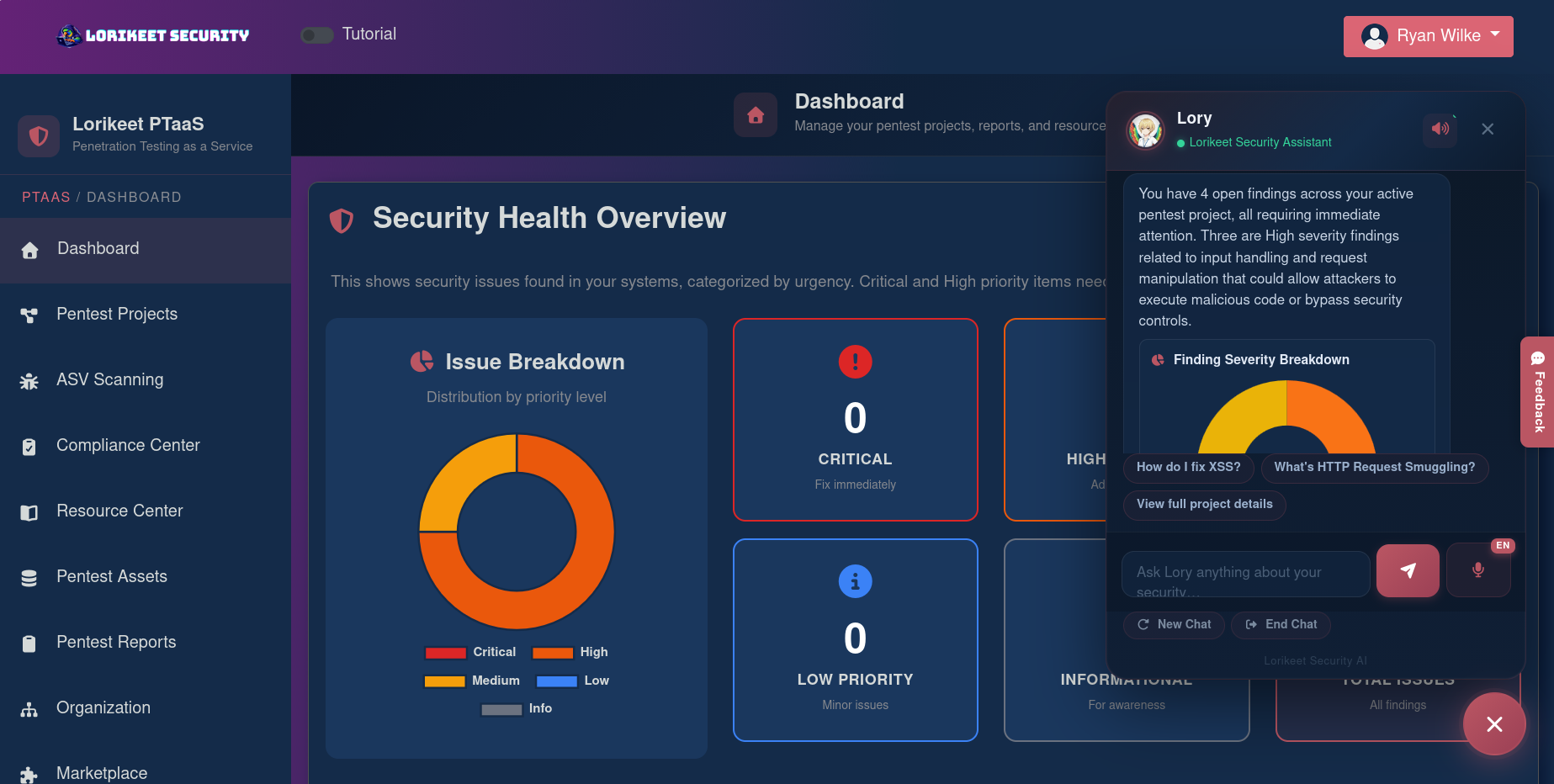
- Real-Time Portal + 24/7 Attack Surface Monitoring
- See new subdomains, exposed services, and third-party script drift in near real time.
- Practical use: Tag assets by campaign code. If a vanity domain suddenly resolves somewhere unexpected, you’ll catch typosquatting before paid traffic lands there.
- 100% Manual Pentesting + Free Retesting
- Researchers test your forms, auth flows, API integrations, and mobile/desktop clients—no scanner noise.
- Practical use: Run a pentest two weeks pre-launch and schedule free retesting 48–72 hours before ads go live to verify fixes.
- Lory, the AI Assistant
- Trained on ~2,000 vulnerabilities, Lory explains risk in plain English and drafts remediation steps for devs and auditors.
- Practical use: Ask “Turn this XSS finding into a Jira ticket with steps, owner, and SLA,” or “Generate a non-technical summary for our enterprise buyer.”
- Compliance Automation with Audit-Ready Reports
- Map controls across SOC 2, ISO 27001, GDPR, PCI-DSS, and more. Lorikeet partners with Vanta/Drata and Accorp Partners CPA to take you from pentest to attestation.
- Practical use: Build a “Security Due Diligence” packet for Sales to share during security reviews. We’ve seen it cut security questionnaire cycles in half.
- Security Awareness Training for Go-To-Market Teams
- Phishing simulations and courses tuned to marketing lures (fake event invites, press outreach).
- Practical use: Run a targeted simulation pre-conference; track completion in a compliance-ready dashboard.
Step 3: Pro Tips for Marketing Professionals
- Build a “Launch Hardening” checklist in the portal: pentest booked, critical fixes merged, free retest passed, uptime runbook ready, and compliance packet delivered to Sales.
- Tag assets by campaign and set a change freeze 72 hours pre-launch. Any high-risk change triggers an automatic retest request.
- Use AI Agent Security Assessments if you run chatbots, lead-qual bots, or AI-written code in your CMS—especially for tools like Lovable, Claude Code, or Cursor.
- Monitor brand and typosquatting domains. Route alerts to PR/Legal with a predefined takedown playbook.
- Leverage compliance mapping for EU buyers: prebuild a GDPR/DORA/NIS2 brief so Procurement can’t stall your PO.
Common Mistakes to Avoid
- Treating security as a one-off scan. Manual pentesting plus continuous monitoring is the combo that actually prevents launch-day surprises.
- Forgetting third-party martech and “shadow” tools (Typeform, Airtable, Zapier). Add every form endpoint and webhook to your asset list.
- Skipping retesting. Free retesting is your best friend; make “retest passed” a go/no-go gate in the launch checklist.
How It Compares to Alternatives
- Flowtriq vs. Lorikeet
- While Flowtriq excels at instant DDoS detection and auto-mitigation to keep servers up during traffic spikes or attacks, Lorikeet is better suited for holistic risk reduction: manual pentesting, 24/7 attack surface monitoring, and compliance artifacts that unblock enterprise deals.
- If your primary problem is uptime under volumetric attack (e.g., launch-day bots), Flowtriq is faster to value. If your blockers are vulnerabilities, security questionnaires, and governance, Lorikeet is the right fit.
- Compared with bug bounty platforms or scanners
- Scanners are noisy and miss business-logic issues; bug bounties can be uneven for pre-launch work. Lorikeet’s researcher-led testing plus free retesting is more predictable for tight campaign timelines.
Conclusion: Is Lorikeet Security Right for You?
If your marketing org ships microsites, gated content, chatbots, calculators, or integrations—and enterprise buyers grill you on security—Lorikeet turns security from a blocker into a launch enabler. You’ll harden experiences before ads run, watch your attack surface 24/7, and hand Sales the audit-ready proof that keeps deals moving. Choose Flowtriq if pure DDoS resilience is your urgent need; choose Lorikeet when you want a full security program in one portal. Because your pipeline shouldn’t stall for fixable security debt. Learn more at https://lorikeetsecurity.com.